
Passenger Manifest Requirements Under Marine Order 504: What Operators Actually Need to Keep
Most operators know they have to keep track of who is on board. Far fewer can say precisely when that becomes a passenger manifest under the law, what has to be on it, and where it has to live.
Marine Order 504 (Certificates of operation — national law) 2024 draws the line at a single number: 12 hours. Get that threshold wrong and you are either carrying a compliance gap or generating paperwork nobody needed.
Here is what the marine order actually requires.
The 12-hour threshold
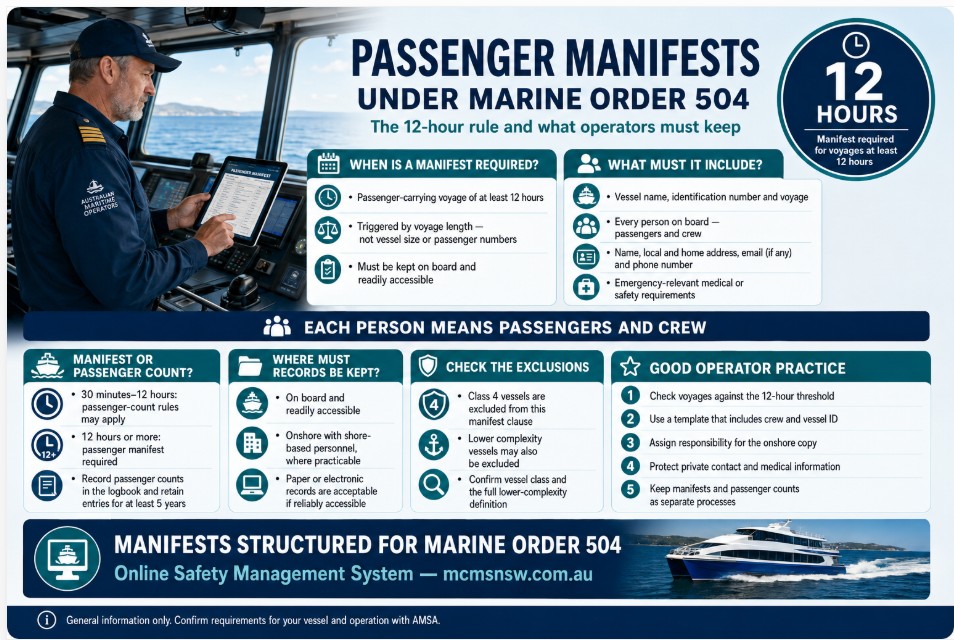
The manifest obligation sits in Schedule 1, clause 15(7). For a vessel carrying passengers, the owner must ensure a passenger manifest is kept on board and readily accessible for any voyage that is at least 12 hours long.
Below 12 hours, there is no manifest requirement under clause 15(7). That surprises operators who assume a manifest is universal for passenger work. It is not — it is a long-voyage control.
Note what triggers it: the length of the voyage, not the size of the vessel, not the number of passengers, not the operational area. A twelve-hour overnight charter triggers a manifest. Six two-hour harbour runs on the same day do not.
What must be on the manifest
Clause 15(8) sets out the required content. The manifest must include:
- the name of the vessel
- the identification number for the vessel
- the voyage
- if required in an emergency, details of any medical or safety requirements of particular passengers
- for each person on board the vessel: name, address (local and home address, if the person has both), email address if any, and phone number
That last item deserves attention. The wording is "each person on board the vessel" — not "each passenger." Read plainly, that captures crew as well. Operators building manifest templates from a passenger-booking list alone risk producing a document that does not meet clause 15(8).
The medical and safety requirements item is conditional — it applies where the information would be required in an emergency. In practice this means dietary and mobility notes taken at booking are not automatically manifest content, but a passenger's declared cardiac condition or a mobility limitation affecting evacuation almost certainly is.
Who is carved out
Two exclusions in clause 15(1) matter.
Class 4 vessels. Clause 15 does not apply to a Class 4 vessel at all. Hire and drive operations sit under Schedule 2, which imposes a different documentation obligation — clause 8 requires written records about the operation sufficient to allow investigation of reportable marine incidents.
Lower complexity vessels. Subclauses 15(7) and 15(8) do not apply to a lower complexity vessel. Under section 4, that means a Class 2, 3 or 4 vessel under 7.5 metres which — for Class 2 — carries no more than four day passengers, and which is not caught by any of the disqualifying features in the definition: carrying dangerous goods as cargo, a net reel or crane or lifting device or deck load affecting stability, operating primarily for towage, an inboard engine on fuel with a flashpoint below 60°C, berthed accommodation, or an operation kind determined by the National Regulator.
Worth checking that definition properly rather than assuming. The exclusions are cumulative, and a single feature drops a vessel out of "lower complexity."
The obligation people confuse it with: passenger counting
This is where operators most often go wrong. A manifest and a passenger count are different obligations, in different clauses, with different triggers.
Passenger monitoring — clause 11(5)(g) requires a procedure for monitoring at all times, using an effective and verifiable method that lets the master determine the number of passengers on board at any time. This applies to Class 1 vessels and to Class 2 vessels permitted to carry passengers.
Passenger counts — clause 11(5)(h) requires a procedure for counting at or around embarkation and disembarkation. It applies where all of the following hold: the vessel is a Class 2 permitted to carry passengers, or a Class 1 permitted to carry no more than 75 passengers; the voyage is scheduled for at least 30 minutes and no more than 12 hours, with no scheduled embarkation or disembarkation stop in the first 30 minutes; and the vessel operates in B, C or D waters, or in E waters outside daylight hours.
Look at the durations side by side. The count regime runs from 30 minutes to 12 hours. The manifest obligation starts at 12 hours. The two are designed to meet, not overlap. Short voyages get counted; long voyages get a manifest.
There is a further wrinkle for water-based activities. Under clause 11(5)(i), a vessel within the counting regime that transports passengers to a water-based activity must conduct an additional count before departing the activity site — but a count is not required each time a passenger enters or leaves the water, or moves to another vessel used with the activity.
The marine order does not prescribe a counting method. The note to paragraph (h) offers head counts, clicker counts, roll calls, electronic sensors, and systems distributing and collecting lanyards or wristbands. Whatever you choose, clause 15(4)(f) requires each passenger count to be recorded in the logbook, and clause 15(6) requires logbook entries to be retained for at least five years.
Where records have to be kept
Clause 15(7) says the manifest is kept on board and readily accessible. But it does not sit in isolation.
Section 9(b) imposes a general condition on every certificate of operation: unless indicated otherwise, matters required to be recorded or kept under Schedule 1 or 2 must be kept both on board the vessel, where practicable given its size and use, and onshore with shore-based personnel.
For a manifest, the onshore copy is arguably the entire point. A passenger list that exists only on a vessel in difficulty is of limited use to the people coordinating a response ashore. Operators should hold both unless they have a considered reason not to, and should confirm their approach with AMSA if their circumstances are unusual.
The note to section 9(b) confirms records may be kept in writing or electronically, provided the recording method is reliable for accessibility purposes. It also flags that failing to provide a required record to a marine safety inspector or the National Regulator on request is an offence under section 83 of the national law.
"Readily accessible" is doing real work in that sentence. A manifest in a personal email account that only the office manager can open, or on a laptop that sails with the vessel, may not clear the bar.
Practical steps
- Map your voyages against the 12-hour line. Identify which scheduled operations cross it. Those are your manifest voyages.
- Check your vessel class and complexity. Confirm whether the Class 4 or lower complexity carve-outs apply before building process you do not need.
- Build the template to clause 15(8), not to your booking system. Include crew. Include vessel ID. Include the voyage.
- Decide how emergency-relevant medical information is captured, stored and restricted. It is the most sensitive field on the document.
- Confirm the onshore copy exists and someone specific is responsible for it. Name the role in your SMS.
- Keep manifests and passenger counts as separate, clearly labelled processes. Crew who understand one obligation and not the other will apply the wrong one.
A manifest holds names, home addresses, contact details and potentially health information. Operators have obligations under Australian privacy law that sit alongside MO504, and a retention and access policy for manifests is worth putting in writing.
Keeping it manageable
None of this is conceptually hard. It becomes hard at scale — across multiple vessels, mixed voyage lengths, changing crew and a five-year retention tail on logbook entries.
That is the problem MCMS is built to solve: manifest and logbook records structured to the marine order, held both on board and ashore, accessible when an inspector asks.
Learn more about Online Safety Management System — visit mcmsnsw.com.au
Questions about the law
When is a passenger manifest required under Marine Order 504?
The obligation is in Schedule 1, clause 15(7). For a vessel carrying passengers, the owner must ensure a passenger manifest is kept on board and readily accessible for any voyage that is at least 12 hours long. Below that threshold there is no manifest requirement under clause 15(7). The trigger is the length of the voyage — not the vessel class, not the number of passengers, not the operational area. A twelve-hour overnight charter requires a manifest; six two-hour harbour runs on the same day do not.
What information must a passenger manifest include?
Clause 15(8) sets out the required content. The manifest must include: the name of the vessel; the identification number for the vessel; the voyage; if required in an emergency, details of any medical or safety requirements of particular passengers; and for each person on board the vessel — name, address (local and home address if the person has both), email address if any, and phone number.
The medical and safety requirements item is conditional — it applies where the information would be required in an emergency. Dietary preferences taken at booking are not automatically manifest content, but a declared cardiac condition or a mobility limitation affecting evacuation almost certainly is.
Does a passenger manifest have to include crew?
Read plainly, yes. Clause 15(8)(e) requires the manifest to include details for each person on board the vessel — not each passenger. That wording captures crew as well as passengers. Operators who build manifest templates from a passenger-booking list alone risk producing a document that does not meet clause 15(8). Note that crew members also appear separately in the crew list required by clause 15(9)–(10), which is a distinct document with its own required fields.
Do Class 4 hire and drive vessels need a passenger manifest?
No. Clause 15(1) states that the entire clause — including the manifest obligation in subclauses (7) and (8) — does not apply to a Class 4 vessel. Hire and drive operations are instead governed by Schedule 2. Schedule 2, clause 8 imposes a different and narrower obligation: the owner must ensure that written records about the operation of the vessel are maintained to allow for investigation of marine incidents required to be reported to the National Regulator. That is a narrower obligation than a full passenger manifest.
What's the difference between a passenger manifest and a passenger count?
They are different obligations in different clauses with different triggers, and they are designed to meet rather than overlap.
Passenger counts (clause 11(5)(h)) apply to Class 2 vessels permitted to carry passengers and Class 1 vessels permitted to carry no more than 75 passengers, where the voyage is scheduled for at least 30 minutes and no more than 12 hours, with no scheduled stop in the first 30 minutes, and the vessel operates in B, C or D waters or in E waters outside daylight hours. The count must be recorded in the logbook under clause 15(4)(f).
Passenger manifests (clause 15(7)) apply to vessels carrying passengers on voyages of at least 12 hours.
The count regime runs from 30 minutes to 12 hours. The manifest obligation starts at 12 hours. Short voyages get counted; long voyages get a manifest.
Can a passenger manifest be kept electronically?
Yes. The note to section 9(b) of the marine order confirms that, unless indicated otherwise, matters may be recorded either in writing or electronically, provided the method of recording is reliable for accessibility purposes. The same note flags that failing to provide a required record to a marine safety inspector or the National Regulator on request is an offence under section 83 of the national law.
"Reliable for accessibility purposes" is doing real work in that phrase. A manifest stored in a personal email account that only one staff member can access, or on a device that sails with the vessel, may not satisfy the standard — particularly given the onshore copy requirement discussed below.
Does a manifest have to be kept on board, onshore, or both?
Clause 15(7) says the manifest must be kept on board the vessel and readily accessible. But it does not sit in isolation. Section 9(b) imposes a general condition on every certificate of operation: unless indicated otherwise, matters required to be recorded or kept under Schedule 1 or 2 must be kept both on board the vessel, where practicable given its size and use, and onshore with shore-based personnel.
For a manifest, the onshore copy is arguably the entire point. A passenger list that exists only on a vessel in difficulty is of limited use to the people coordinating a response ashore. Operators should maintain both copies unless they have a considered reason not to, and should confirm their approach with AMSA if their circumstances are unusual.
See the Passenger Manifest Feature in SMS Marine
SMS Marine builds the Marine Order 504 passenger manifest directly into the app — type passengers on screen or import a CSV from your booking system, then print a clean, branded manifest in one click. Every voyage is retained alongside your logbook, ready for AMSA on request.
See the Passenger Manifest FeatureThis article is general information about Marine Order 504 (Certificates of operation — national law) 2024, current as at the date of publication. It is not legal advice. Operators should read the marine order in full and confirm requirements for their specific vessels and operations with AMSA. The current instrument is available on the Federal Register of Legislation and via amsa.gov.au.